
The Miami County Auditor GIS & Maps page provides a centralized view of property and parcel information through a location-based mapping system. The page displays the Miami County GIS map with parcel outlines, boundary lines, and recorded land details tied to county records. Property data appears in map form to support visual reference and public review. Parcel locations align with auditor records used for mapping and assessment reference. The layout focuses on clarity so users can identify parcels and related map details without confusion. Each map view reflects recorded county data presented in a consistent format.
This Miami County Auditor GIS resource serves property owners, buyers, real estate professionals, and public record users seeking accurate parcel-level mapping details maintained by the Miami County Auditor. Through this system, users can search parcels, view Miami County Auditor parcel map boundaries, and review location-based information connected to official county files. The mapping interface displays parcel shapes, boundaries, and related geographic features that align with records overseen by the Miami County Auditor for reference purposes.
What Is the Miami County Auditor GIS System?
The Miami County Auditor GIS system is a county mapping system that displays property and parcel information on interactive maps. It uses a geographic information system to show public GIS data in a clear, visual format tied to county records. The Miami County Auditor’s GIS brings property data and maps into one place. It combines location details with auditor records, so users can see parcels, boundaries, and related attributes on a single screen. This county auditor’s GIS maps platform turns rows of data into visual information that is easier to read and compare. As a result, users can see how parcels relate to roads, boundaries, and nearby properties.
A geographic information system works by linking map locations with data stored in county databases. Each parcel connects to records such as parcel numbers, land use, and mapped boundaries. These records form part of the county mapping system maintained by the auditor’s office. The system shows public GIS data for reference and general use, based on information recorded by county offices.
Key features commonly shown in the Miami County Auditor GIS include:
- Parcel boundaries displayed on interactive maps
- Map layers that show parcels, roads, and administrative lines
- Linked parcel details connected to mapped locations
- Public-facing data presented for transparency and clarity
Why the County Auditor Uses GIS Maps
County auditor GIS maps support daily property record work. The system helps to invariably present parcel information across the county. Map visuals reduce confusion that can occur with text-only records. For example, boundary lines and parcel shapes appear clearly on the map, which supports public review of county records. Public GIS data shown in the Miami County Auditor GIS reflects recorded information at the time of posting. Update schedules vary by data source, so mapped details may change as records update. Even so, the system builds trust by showing where information comes from and how parcels fit within the county’s mapped structure.
How Miami County GIS Maps Work
Miami County GIS maps allow users to view property information, parcel boundaries, and land details in a clear, interactive format. These maps combine multiple layers of geographic data, providing a visual way to explore property and land records throughout the county. Miami County’s GIS map uses interactive maps to display detailed parcel boundaries, zoning information, and infrastructure data. Users can select individual parcels to see property ownership, tax data, and other county records. Each map layer can be toggled on or off, making it simple to focus on the information most relevant to a user’s needs. By layering data such as land use, streets, and utilities, these maps give a comprehensive visual representation of county properties.
Data Layers Explained
The GIS system organizes information into several layers that can be individually displayed:
- Parcel boundaries: Highlight property lines for every parcel in Miami County.
- Zoning and land use: Show permitted land uses and zoning classifications.
- Infrastructure: Include roads, utilities, and public facilities.
- Topography and environmental features: Highlight terrain, water bodies, and flood zones.
Each layer contributes to a more complete understanding of land distribution and property data. Users can view all layers simultaneously or focus on one to analyze specific aspects of the land.
Map Navigation Basics
Interacting with the map is straightforward. Users can:
- Zoom in and out to see detailed property lines or a broader county overview.
- Pan across the map to examine different areas.
- Select parcels to view detailed ownership, tax, and land use information.
- Toggle layers on or off to simplify the map view.
These tools help users analyze property information efficiently, whether for research, planning, or personal reference.
Why GIS Data Is Visual
Visual representation makes complex properties and geographic information easier to understand. Seeing parcel boundaries, land use, and infrastructure on a map allows users to quickly identify property locations, relationships between parcels, and geographic context. Interactive features such as layer toggling and parcel selection provide an engaging and informative experience, improving clarity compared to traditional text-based property records.
Auditor Parcel Maps Explained
An auditor parcel map provides a detailed visual representation of property boundaries, parcel numbers, and land divisions within Miami County. These maps are essential tools used by auditors to track property ownership, tax information, and geographic layouts. Miami County parcel maps display individual parcels of land with clear boundary lines, often overlaid on roads, landmarks, and natural features. Each parcel is assigned a unique parcel number, which links the physical property to official records in the auditor’s database. This connection allows both officials and the public to reference property ownership, zoning classifications, and assessment data with accuracy.
Key Features of Auditor Parcel Maps
- Parcel Number Map: Every property has a unique identifier used for tracking taxes and ownership.
- Property Boundary Map: Clearly shows the edges and dimensions of each parcel.
- Tax Parcel Map: Connects parcels to their assessed value and tax information, facilitating accurate recordkeeping.
Auditor parcel maps are frequently used in planning, property development, and public record verification. They help identify land boundaries during transactions, assist with taxation purposes, and provide a reliable reference for surveyors and planners. By displaying each parcel in relation to nearby properties, roads, and geographic markers, these maps allow for precise comparison and analysis.
How Auditors Use Parcel Maps
Auditors rely on parcel maps to:
- Verify property ownership and boundaries for tax assessment.
- Maintain accurate land records and ensure legal compliance.
- Cross-reference parcel numbers with GIS datasets for property management.
- Update maps to reflect subdivisions, annexations, or changes in land use.
Each Miami County parcel map integrates geographic information system (GIS) data, offering a layered approach that shows zoning, land use, and environmental features. This structured presentation ensures both transparency and reliability in property assessment and reporting.
Search Property & Parcel Information Using GIS
Users can quickly locate property details in Miami County by performing a GIS parcel lookup. The system allows searches by parcel number, address, or owner name, providing an organized view of property and land information. The Miami County property GIS system offers a range of tools to make property research straightforward and accurate. Users can enter a parcel number directly https://www.miamicountyohioauditor.gov/Search to pinpoint a specific property, or use an address search to locate parcels within a neighborhood or district. Additionally, an owner lookup helps identify property holdings for individual owners, which is useful for property research, tax planning, or verification purposes.
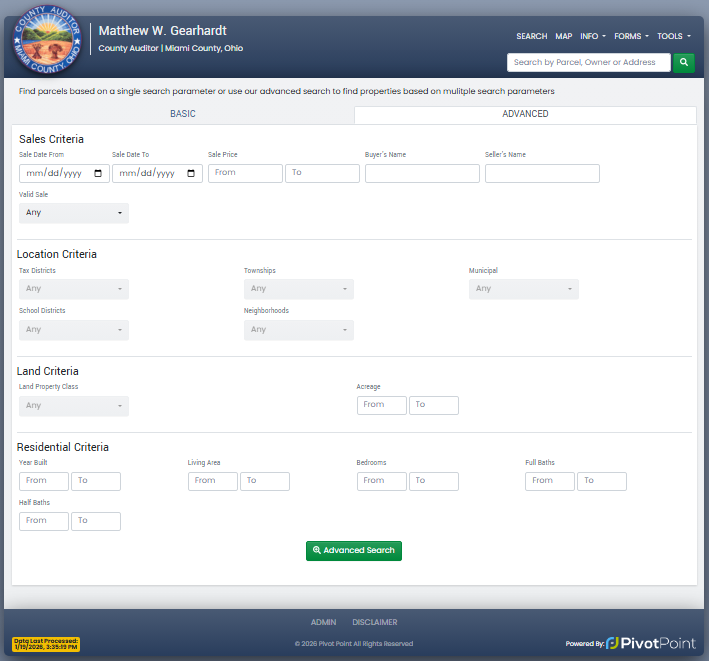
Once a search is submitted, the GIS displays results in a clear, interactive map format. Each property parcel is highlighted, showing boundaries, lot dimensions, and relevant property information such as land use, zoning classification, and tax identifiers. Users can click on parcels to reveal detailed property records, including ownership history, assessed values, and parcel identification numbers.
Search Methods
- Parcel Number Lookup: Enter the unique parcel ID to locate a specific property immediately.
- Address Search: Input the street address to find all parcels associated with that location.
- Owner Lookup: Type the name of a property owner to view all parcels registered to them.
These search methods are integrated with the interactive county map, allowing users to visualize property locations and relationships. The map includes zoom, pan, and layer options to explore details like zoning boundaries, neighborhood layouts, and public infrastructure. Highlighted parcels display pop-up windows with summary information, which makes comparing multiple properties simple and efficient. Users can also export map data or take screenshots for reference. Layer controls enable the display of property boundaries, lot sizes, and adjacent parcels, enhancing clarity and usability. For example, selecting the zoning layer shows whether a parcel is residential, commercial, or agricultural, while parcel overlays provide insight into land usage patterns across the county.
Available GIS Map Layers in Miami County
Miami County GIS map layers provide detailed visual information about property boundaries, land use, and local administrative divisions. These layers allow residents, officials, and professionals to analyze property data accurately and efficiently. The county’s GIS system organizes information into multiple layers that can be toggled on or off depending on the user’s needs. Key layers include:
Parcel Boundaries
This layer shows the exact property lines for every parcel within the county. Each parcel is linked to the auditor’s records, allowing users to cross-reference ownership, assessment values, and tax data. Parcel boundaries are crucial for property planning, legal references, and development projects.
Zoning Boundaries
Zoning boundaries define land use regulations across the county. They indicate areas designated for residential, commercial, industrial, or agricultural purposes. This layer helps property owners, developers, and planners determine what types of structures or activities are permitted on specific parcels.
Administrative Boundaries
Administrative boundaries outline districts, townships, municipalities, and other jurisdictional divisions. These layers assist in determining voting districts, school zones, and service areas. They also provide essential context for public services and planning decisions.
Land Records GIS
The land records GIS layer integrates historical and current property records, including deeds, easements, and land transfers. Users can visualize ownership changes over time, which is valuable for research, legal matters, and property verification.
How the Auditor Uses GIS for Property Records
The Miami County Auditor relies on GIS technology to manage and visualize property information accurately. By integrating spatial data with property records, the auditor ensures that assessment data, land records, and property valuation are easily accessible and well-organized. The county auditor’s GIS system allows officials to view detailed property records and maps, linking each parcel to ownership, assessment, and land-use information. This integration helps maintain current records for taxation and public reference. Unlike the treasurer, who focuses on collecting property taxes, the auditor’s office is responsible for recording, mapping, and analyzing property data. This distinction ensures that property valuations and legal land descriptions are precise and publicly available.
How GIS Supports Property Management
GIS enables the auditor to:
- Display parcel boundaries clearly on digital maps.
- Integrate assessment data with geographic information to monitor property values over time.
- Maintain accurate land records, including historical ownership and subdivision layouts.
- Identify properties for zoning, planning, and public reporting.
By using a property records map, officials can quickly locate parcels, cross-reference owner information, and track changes in land use. These maps also support decision-making for both county administration and residents seeking property details.
Benefits of Using Miami County Auditor GIS Maps
The Miami County GIS map provides residents and professionals with clear visual property data that simplifies property-related tasks. It allows users to examine parcels, boundaries, and land information efficiently, offering a reliable tool for local property management and planning. Using these public access maps helps homeowners, real estate professionals, and government staff make informed decisions. The interactive system presents location-based records in a structured format, making it easier to compare properties, assess land use, and evaluate zoning considerations. By presenting spatial information visually, the GIS map reduces the risk of errors in property interpretation and facilitates quick reference to critical data.
Key advantages include:
- Quick parcel identification: Users can locate property boundaries, lot sizes, and parcel numbers with clarity.
- Zoning and land use clarity: Maps display zoning categories and land classifications that aid decision-making for construction, investment, or planning.
- Improved property management: Government offices, surveyors, and developers can track property changes over time using accurate GIS layers.
- Public accessibility: Residents gain transparent access to property data without needing specialized software or extensive paperwork.
The Miami County GIS map also enhances collaboration among county offices by providing a single, centralized source of spatial information. Layered data allows professionals to cross-reference property records, flood zones, and infrastructure details simultaneously. By integrating maps with parcel records, the system increases efficiency and reduces the likelihood of errors in planning or reporting.
(FAQ) About GIS Map
The Miami County auditor’s GIS and auditor parcel map provide reliable property and parcel information for residents, researchers, and professionals. Users can view interactive maps, assess parcel boundaries, and access public records data efficiently. This FAQ addresses common concerns about using the system and provides clear guidance on the most frequent questions.
How accurate is the Miami County GIS map?
The Miami County GIS map offers highly accurate property and parcel data suitable for most public and research purposes. While the system is regularly updated with information from the auditor and land records, minor differences can occur due to recent changes in ownership, new subdivisions, or survey adjustments. The GIS system is designed to assist with property searches, parcel lookup, and map visualization, but official surveys or auditor records should be consulted for precise legal or boundary confirmations.
Why parcel boundaries may differ
Parcel boundaries on the auditor GIS map may not always match physical markers or private surveys exactly. These differences arise because the maps reflect recorded property data rather than real-time survey measurements. Updates, land subdivisions, consolidations, or minor software approximations can result in slight variations. Despite this, the auditor parcel map remains a reliable reference for general property research, zoning reviews, and visual assessment of parcel layouts.
Can GIS data be used for legal decisions?
The Miami County auditor’s GIS and parcel maps are intended for informational purposes and public use but should not be relied upon as the sole source for legal matters. While the maps provide accurate property layouts and ownership records, official surveys and certified documents are required for legal proceedings. Users can utilize the GIS system for property research, parcel lookup, and planning, but verifying boundaries and ownership through official auditor records ensures complete accuracy for legal or formal property decisions.
How often is the auditor’s parcel map updated?
The auditor parcel map is updated frequently to reflect new property records, ownership changes, and land subdivisions. Updates occur as new information is recorded with the Miami County auditor’s office, and GIS layers are refreshed to maintain accuracy. This ensures that property data, parcel boundaries, and public records remain current. Users can rely on the map for an accurate visual representation while remaining aware that very recent changes may not immediately appear until processed by the auditor’s office.
What if a property does not appear?
Occasionally, a property may not be visible on the Miami County auditor’s GIS or parcel map due to recent recording delays, new construction, or incorrect search entries. When this happens, verifying the parcel number or address and consulting the Miami County auditor’s office can resolve the issue. Official records will confirm ownership and property details, and any missing parcels are typically added to the GIS system promptly. Even if a property is temporarily absent from the map, the auditor’s data ensures the information can be verified and updated accurately.