The Miami County Recorder is the official office responsible for maintaining all property and land records in Miami County, Ohio. It provides accurate and legally recognized documents such as deeds, mortgages, liens, plats, and affidavits. Homeowners, attorneys, title companies, and researchers rely on the Recorder’s Office to verify property ownership, track legal transfers, and ensure that all land records are properly indexed and preserved. By keeping a complete chain of title, the office safeguards ownership rights and supports smooth property transactions across the county.
The Miami County, Ohio, Auditor plays a key role in maintaining accurate and accessible property records, serving as a vital resource for residents, researchers, and legal professionals alike. Through this office, users can easily conduct land record searches, request certified copies, or explore recent filings using official online platforms. The Miami County Ohio Auditor ensures that all documents comply with Ohio laws and recording standards, providing transparency and security in every transaction. Maintaining organized and detailed records helps prevent disputes, confirms legal ownership, and allows property histories to be traced across decades. Each recorded document strengthens public trust and supports informed decisions in property matters.
What Is the Miami County Recorder’s Office?
The Miami County Recorder’s Office is the official government office responsible for maintaining land and property records in Miami County, Ohio. It records, indexes, and preserves deeds, mortgages, liens, and other public documents for the county. The Recorder’s Office operates under the authority of the Ohio Revised Code, which defines its responsibilities and ensures that property transactions and official filings are properly documented. This office plays a vital role in keeping land records, maintaining permanent records, and safeguarding the history of property ownership. Every document recorded becomes part of a permanent legal record, available for public reference.
Role and Responsibilities
The office carries out several key functions to support property ownership, legal transactions, and community transparency:
- Recording Documents: All deeds, mortgages, liens, easements, and plats are officially recorded. This ensures legal recognition of property ownership and other rights.
- Indexing Records: Each recorded document is carefully indexed by property owner, document type, and date, allowing efficient searches for current and historical records.
- Preserving Documents: The Recorder’s Office maintains both physical and digital copies of records, protecting them against damage or loss over time.
- Providing Public Access: While respecting legal privacy standards, the office makes land records and official filings available for review.
Who Uses These Records?
Various individuals and organizations rely on the Miami County Recorder’s Office:
- Homebuyers and Property Owners: Verify ownership, review liens, or examine historical deeds before buying or selling property.
- Legal Professionals: Attorneys and title companies use recorded documents for real estate transactions, estate planning, and dispute resolution.
- Researchers and Historians: Accessing older property records provides insight into the county’s development and historical ownership.
- Government Agencies: Rely on accurate records for taxation, zoning, and urban planning.
The office ensures that all recorded documents comply with Ohio law, specifically sections outlined in the Ohio Revised Code 317.312, which governs recording procedures, document validity, and fee requirements. By maintaining a reliable system of official filings, the Miami County Recorder helps protect property rights, prevent disputes, and maintain accurate historical records.
Types of Documents You Can Find
The Miami County Recorder’s Office maintains a wide variety of official documents related to property and land ownership. Residents and professionals can find records that detail ownership, legal agreements, and property boundaries. The office keeps records of deeds, mortgages, liens, plats, affidavits, easements, land contracts, and more, ensuring that property information is preserved accurately and securely. These documents serve multiple purposes, from verifying ownership to supporting legal and financial transactions.
Deeds: Legal Transfers of Ownership
Deeds are official records that show the transfer of property from one owner to another. They provide legal proof of ownership and often include details like the property description, seller and buyer names, and the date of transfer. Individuals, real estate professionals, and attorneys frequently reference deeds to confirm ownership history or resolve disputes.
Mortgages: Recording Financial Liens
Mortgages are recorded to document liens on properties. These records protect lenders by legally recording debt obligations tied to a property. Anyone purchasing a home or researching property history can consult mortgage records to verify if outstanding loans exist.
Liens: Protecting Legal and Financial Interests
Liens include judgments, tax claims, or mechanics’ liens. They indicate that a third party has a legal claim on a property due to unpaid debts or obligations. Accessing lien information can help potential buyers or legal professionals avoid conflicts before transactions occur.
Plats: Maps and Property Layouts
Plats are detailed maps showing property boundaries, subdivisions, and land parcels. They are crucial for builders, developers, surveyors, and property owners who need precise measurements and legal descriptions. Plats also help in confirming property lines during disputes or construction planning.
Affidavits, Easements, and Land Contracts
The Recorder’s Office also stores affidavits, which are sworn statements related to property matters. Easements describe rights that allow others to use part of a property for specific purposes, such as utilities or access paths. Land contracts are agreements between a buyer and seller outlining payment terms and property transfer conditions.
Historical Records: Back to 1807
Miami County’s records extend back to 1807, offering a long history of property ownership and legal filings. Historical documents can assist genealogists, historians, and legal professionals in tracing property lineage or verifying past ownership. Special procedures may apply for accessing older records to preserve their condition.
Benefits of Using These Records:
Protects property interests in legal or financial transactions
- Confirms legal ownership and property history
- Documents financial obligations tied to real estate
- Provides boundary and survey information for development
How to Search Miami County Land Records
Searching Miami County land records is straightforward using either free online tools or remote access systems. Property owners, attorneys, and researchers can efficiently locate deeds, mortgages, and other recorded documents through these official resources. Accurate record searches are essential for confirming ownership, tracking liens, or reviewing legal documents. The Miami County Recorder’s Office provides multiple options to help users perform these searches effectively, including online portals and historical indexes. This section explains each method with step-by-step instructions and tips for precise results.
Search Online
The AVA (Direct Search) tool is the primary free resource for searching property records in Miami County. Users can search by owner name, property address, or document number to retrieve images of recorded documents.
Steps to use AVA Direct Search:
- Visit the official AVA search portal: AVA Direct Search
https://rep4laredo.fidlar.com/OHMiami/DirectSearch/#/search
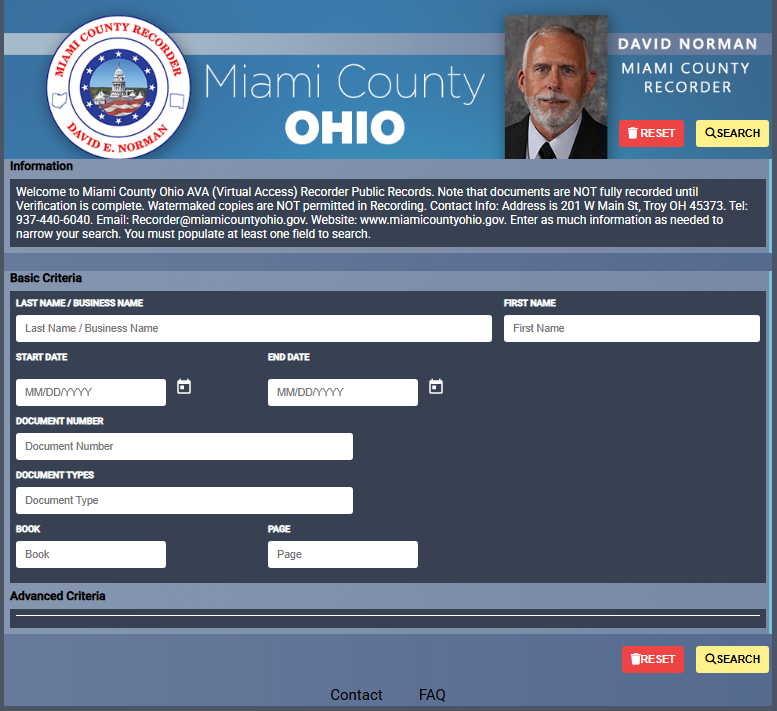
- Enter the property owner’s name in the search field.
- Click Search to view a list of matching documents.
- Select the desired document by clicking the document number.
- Click the image thumbnail to view or print the full record.
Details to note:
- Records are available for deeds, mortgages, liens, and other filings.
- The AVA system displays the recorded date, book and page numbers, and document type.
- Users can print documents directly from the portal without additional fees.
Using the AVA tool ensures that property record searches are accurate, free, and official, providing the most current documents available.
Using Laredo Anywhere
For users requiring more extensive search capabilities, Laredo Anywhere offers a remote account option. This platform allows registered users to access scanned document images, perform advanced searches, and maintain a history of viewed records.
How to set up a Laredo Anywhere account:
- Go to Laredo Anywhere Account Setup
https://fidlar.com/Laredo.aspx

- Complete the registration form with your name, email, and contact information.
- Once registered, log in to the portal.
- Use the search features to locate documents by owner name, address, or document number.
- View full document images and download or print as needed.
How to Search Historical Documents: Pre‑1998
Older property records may not be fully digitized in online databases. For documents recorded before 1998, users must rely on geographical or name indexes maintained by the Miami County Recorder.
Steps for historical searches:
- Determine the approximate recording date of the document.
- Access the Recorder’s Office index books either online via Laredo Anywhere or by contacting the office for guidance.
- Search by owner name, book and page numbers, or property description.
- Request assistance for pre-1980 deeds, which may require physical retrieval.
How to Request Copies or Certified Documents
If you need a copy of a deed, mortgage, lien, or other recorded document in Miami County, you can request it either online for free or obtain a certified copy for a fee. The Recorder’s Office offers clear procedures to ensure your request is processed quickly and accurately.
Free Online Document Access
Miami County provides tools for residents to search and view recorded documents at no cost. One option is the Direct Search tool, where users can:
- Visit the official Miami County Direct Search portal.
https://rep4laredo.fidlar.com/OHMiami/DirectSearch/#/search
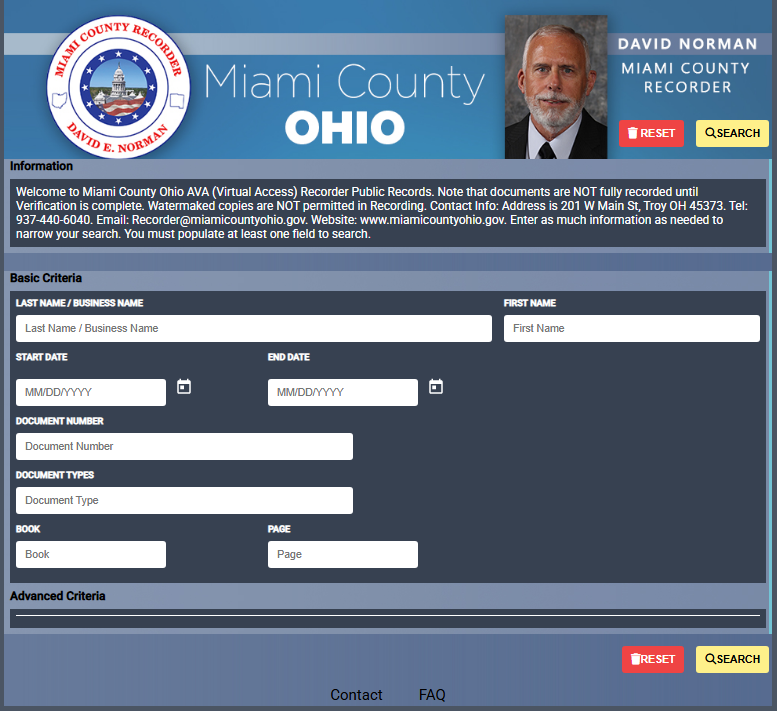
- Enter the property owner’s name or document details in the search bar.
- Browse the results and click the document number of interest.
- Open the image thumbnail to view or print the document.
Another option is the Laredo Anywhere platform, which allows users to set up a free account for broader searches. This system is especially useful for documents dating back decades. For deeds before 1980, contacting the Recorder’s Office directly is recommended for assistance.
Requesting Certified Copies
If a certified copy is required for legal, financial, or official purposes, the Miami County Recorder’s Office processes these requests via mail, email, or in-person submission.
How to submit a request:
- Include your full name, mailing address, and contact information.
- Specify the type of document (deed, mortgage, lien, etc.) and the document number or book and page reference, if known.
- For historical or complex documents, include any details that help the office locate the record quickly.
Fees and Payment Options
Effective as of January 1, a fee of $2.00 per page applies for documents requested by email. Payment can be made via:
- Credit or debit card
- Check
The fee structure ensures requests are processed efficiently. Free online access via the Direct Search tool or Laredo Anywhere platform remains available for standard viewing and printing.
| Request Type | Fee | Payment Method |
|---|---|---|
| Certified document (email/mail) | $2 per page | Credit/debit card or check |
| Online free search | $0 | N/A |
Document Recording & E‑Recording Services
The Miami County Recorder’s Office records land and property documents efficiently, offering multiple ways to submit documents, including in-person, by mail, or through e-recording vendors. These services follow strict Ohio standards to ensure every document is legally valid and properly indexed. Submitting documents for recording in Miami County is a straightforward process that protects property rights and maintains accurate public records. The office handles deeds, mortgages, liens, plats, and other official filings, ensuring they meet the legal requirements of the Ohio Revised Code.
Submitting Documents In-Person
Residents or professionals can visit the Recorder’s Office at 201 West Main Street, Troy, OH 45373 to record documents directly. In-person submissions allow staff to verify conforming documents, answer questions, and process payment immediately. The office accepts checks or credit/debit cards for any recording fees.
Key tips for in-person recording:
- Bring the original documents with all signatures.
- Include all necessary attachments, such as legal descriptions or exhibits.
- Verify that the margins, font size, and signatures comply with Ohio recording standards.
Recording by Mail
Mail submissions are a convenient option for those unable to visit the office. To record by mail:
- Complete all documents with required signatures.
- Include a check or money order for the recording fee ($2.00 per page as per Ohio Revised Code 317.312).
- Provide a self-addressed stamped envelope if requesting copies to be returned.
- Clearly label the package with the office’s mailing address.
Staff will review each document for conformity, process the recordation, and return the filed copies promptly. This method is often used by title companies or attorneys handling multiple transactions.
E‑Recording Miami County
For faster submission, the Recorder’s Office supports e-recording through approved vendors. This digital process allows users to submit documents online, reducing delays and providing instant confirmation of recording. Steps include:
- Choose an e-recording vendor recognized by the Recorder’s Office.
- Prepare electronic documents in the required PDF format.
- Follow vendor instructions for submission, payment, and document indexing.
- Receive a confirmation receipt with the official recorded document number.
E-recording is particularly beneficial for attorneys, title companies, and real estate professionals, offering secure and rapid recordation without visiting the office.
Conforming vs. Non-Conforming Documents
The Recorder’s Office only accepts conforming documents, which meet specific legal and formatting standards. Non-conforming documents may be returned for corrections, delaying the recordation process. Common reasons for non-conformance include:
- Missing or illegible signatures.
- Incorrect or incomplete legal descriptions.
- Margins, font size, or paper type that do not comply with Ohio standards.
Staff reviews each document carefully to ensure proper indexing and compliance with the Ohio Revised Code recording rules. Properly recorded documents create a reliable public record, preserving the chain of title for property ownership and legal transactions.
About Document Standardization & Non‑Conforming Documents
Non‑conforming documents in Miami County are those that do not meet the Ohio recorder standards. These issues often result in delays or rejection when submitting deeds, liens, or other official filings. Document standardization ensures that all recorded documents are clear, legible, and legally valid. The Miami County Recorder’s Office follows strict standards covering font size, margins, ink colors, and paper quality. Submissions that fail to meet these standards are considered non‑conforming documents, which may be returned to the sender or require corrections before acceptance.
Standardization Guidelines
Proper formatting helps prevent mistakes and preserves records for public and legal use. Key standards include:
- Font Size: Documents should use 10–12 point type in a readable font such as Times New Roman or Arial.
- Margins: Maintain at least a 1-inch margin on all sides of the document.
- Ink Colors: Black or blue ink is required; pencil or light-colored ink is not accepted.
- Paper Quality: Use standard letter-sized (8.5 x 11 inches) white paper; oversized or colored sheets may be rejected.
- Signatures: All signatures must be original; stamped or printed signatures are not valid.
These requirements are part of the Ohio recorder standards and help maintain consistency across Miami County’s land and property records.
Why Compliance Matters
Failing to meet these standards can cause several issues:
- Delayed recording or rejection of important documents.
- Increased administrative workload for both the office and the submitter.
- Potential legal complications if documents are deemed invalid.
Following the official formatting rules ensures that records are accepted promptly and remain legally binding. Non‑conforming submissions often require resubmission, which can delay transactions such as property sales or lien filings.
Office Contact & Essential Info
The Miami County Recorder’s Office can be reached by mail, phone, fax, or email, making it easy for residents to handle property records or official filings. Its physical location in Troy, Ohio, serves as the central hub for public land records and document requests. The Miami County Recorder’s Office is located at 201 West Main Street, Troy, OH 45373, providing a convenient address for in-person visits and document submissions. For those needing immediate assistance, the office can be contacted by phone at (937) 440-6040 or fax at (937) 440-6041. Additionally, inquiries can be sent via email through the official recorder contact form.
Office Hours:
- Monday – Friday: 8:00 AM – 4:00 PM
To help residents plan their visits, the office observes the following holidays in 2026:
| Holiday | Date |
|---|---|
| New Year’s Day | January 1, 2026 |
| Martin Luther King Jr. Day | January 19, 2026 |
| President’s Day | February 16, 2026 |
| Memorial Day | May 25, 2026 |
| Juneteenth | June 19, 2026 |
| Independence Day | July 4, 2026 |
| Labor Day | September 7, 2026 |
| Columbus Day | October 12, 2026 |
| Veterans Day | November 11, 2026 |
| Thanksgiving Day | November 26, 2026 |
| Christmas Day | December 25, 2026 |
(FAQ) About Miami County Recorder
The Miami County Recorder’s Office receives many questions from residents, attorneys, and title companies about how to access property records, obtain copies, and understand document requirements. This section answers the most common inquiries, providing step-by-step guidance and practical tips for using official tools and services.
How do I obtain a copy of my deed, mortgage, lien, or other recorded document?
To obtain a copy of a deed, mortgage, lien, or other recorded document, individuals can request records directly from the Miami County Recorder’s Office using online tools or by contacting the office. The AVA Direct Search system allows users to enter the property owner’s name, locate the document number, and access an image of the record to print or save. For more comprehensive searches, the Laredo Anywhere platform provides account-based access to view and download documents remotely. Documents requested by email are subject to a $2.00 per page fee, payable by check or credit/debit card. Historical documents before 1980 may require direct assistance from office staff to ensure proper access. Following these steps helps ensure that records are retrieved accurately and efficiently for legal, professional, or personal purposes.
Are Miami County Recorder’s Office records available online?
Many of the Miami County Recorder’s Office records are accessible online, including deeds, mortgages, liens, and other official filings dating back to 1998. Users can utilize the AVA Direct Search tool to locate documents by owner name or document number, view document images, and print them directly. Laredo Anywhere offers account-based access for more frequent or detailed searches, providing a convenient way to access official records without visiting the office. Historical records or documents before 1980 may still require assistance from staff for access. These online tools make it easier for residents and professionals to retrieve property records while following the office’s official procedures and Ohio law.
Why is my document considered “non‑conforming”?
A document is considered non-conforming when it does not meet the official recording standards of the Miami County Recorder’s Office and the Ohio Revised Code. Issues such as missing signatures, improper margins, incorrect formatting, or incomplete legal descriptions can make a document non-conforming. Non-conforming documents cannot be recorded until corrected, and the office will help submitters fix these errors. Following the official standards ensures documents are preserved properly in the official archives. Preparing documents correctly prevents delays and guarantees that deeds, liens, mortgages, and other filings are officially recognized.
How long does it take to get certified copies?
Certified copies of deeds, mortgages, liens, or other recorded documents typically take one to three business days to process for in-office or mail-in requests. Online searches through AVA Direct Search or Laredo Anywhere may provide immediate access to digital images of documents, but certified copies still require processing for official validation. Requests for historical records or documents that need special handling may take longer. Fees are charged per page, and payment must be completed before the certified copies are released. By providing complete information such as document numbers or property owner names, users can help the office process their requests more efficiently.
Can anyone access Miami County property records?
Miami County property records are public documents, available to anyone under the Ohio public records law. Residents, attorneys, title companies, and other parties can search deeds, mortgages, liens, and other official filings. Most documents from 1998 onward are accessible online through AVA Direct Search or Laredo Anywhere, while historical or sensitive documents may require assistance from staff. Public access ensures transparency for property ownership and legal filings while protecting the integrity of official records. Individuals can verify ownership, review property transactions, and obtain filings while complying with office policies.