
Miami County property tax records show how property taxes are calculated, billed, and paid within the county. These records help users review tax bills, assessed value, and payment history tied to a specific property. They give a clear picture of yearly tax responsibility for homes, land, and commercial parcels in Miami County. Property tax records also support transparency by showing how values and charges change over time.
Miami County property tax records, accessible through the Miami County Auditor’s Home, support property owners, buyers, lenders, and researchers who need clear tax-related details for real estate decisions. Each record connects a property to its assessed value, which forms the base for annual Miami County property tax charges. Tax bills reflect local rates and approved levies, giving a clear view of what a property owes each cycle. Payment history shows past payments and any remaining balances, helping users confirm status before a sale, refinance, or financial review. By visiting the Miami County Auditor’s Home, users can efficiently navigate these records and access accurate, up-to-date tax information in one centralized location.
What Are Miami County Property Tax Records?
Miami County property tax records are public documents that show how much property tax a parcel is charged, billed, and paid over time. These records support property tax lookup in Miami County by displaying values, tax amounts, and payment details tied to each property.
Definition of Miami County Property Tax Records
Miami County property tax records refer to official data maintained by county offices that track real estate tax activity. These records connect each property to a parcel number, which acts as a unique identifier in the county system. Every parcel listed on the local tax roll carries financial and descriptive data linked to that property. The records are compiled from auditor records, valuation updates, and tax billing reports. They reflect how local tax laws apply to residential, agricultural, and commercial property. As a result, the records present a clear financial snapshot for a specific parcel during each tax year.
What Information Is Included in Property Tax Records
A property tax lookup in Miami County typically displays several key data points. Each item serves a specific purpose for owners, buyers, and researchers.
Common details found in Miami County property tax records include:
- Parcel number and property address
- Owner’s name listed in the auditor records
- Current and prior assessed value figures
- Annual and semiannual tax bills
- Payment status and payment history
- Applicable exemptions or credits
- Penalties tied to late or unpaid taxes
Some records extend back multiple years. This long-term data helps users track changes in valuation and tax responsibility across time.
Why Miami County Property Tax Records Matter
Property tax records play a key role in property ownership decisions. Homeowners rely on them to verify tax accuracy and confirm paid balances. Buyers review past tax bills to estimate ongoing ownership costs. Lenders, title professionals, and real estate agents reference these records during property transfers. Local agencies use the same data to confirm compliance with county tax rules. Since the records come from official county sources, they provide reliable insight tied to each parcel on the tax roll.
How to Look Up Property Tax Records in Miami County
Property tax records in Miami County can be found online by using the county’s official property records search systems. A property tax lookup in Miami County allows users to view tax bills, assessed value, and payment history using basic property details. Miami County offers public-facing tools connected to the Auditor’s tax database. These tools are built for homeowners, buyers, sellers, and researchers who need clear tax information without visiting a county office.
Steps Property Tax Lookup Process
The Miami County property tax search process follows a clear structure that works for most users. Each step helps narrow results and leads to a detailed tax record.
- Visit the official Miami County online tax portal used by the Auditor’s office.
- Open the property records search section from the main menu.
- Select a search type based on the details available.
- Enter the information and submit the search.
- Choose the correct parcel from the results list.
Search results usually load within seconds. Most users see one or more matching properties linked to full tax record pages.
Search by Owner Name, Parcel Number, or Address
The property tax lookup Miami County system supports multiple search options. Each method pulls data from the same tax database.
- Owner name search
This option works well for homeowners. Enter a full or partial name to see all related parcels. - Parcel number search
Parcel numbers give the most direct results. This method fits real estate professionals and title researchers. - Address search
Street address searches work for residential and commercial properties. Short street names often return cleaner matches.
Trying more than one search type often improves accuracy.
What Users See After Searching
After selecting a property, the system opens a detailed tax record page. This page presents a complete snapshot of the property’s tax status.
Common details include:
- Current and prior tax bills
- Assessed value and taxable value
- Tax due dates and installment amounts
- Payment history with posting dates
- Parcel data and property classification
Many records display links to past years, which helps users track tax changes. Payment history sections show paid, unpaid, and pending amounts.
Miami County Auditor Internal Tax Tools Page
Miami County provides an additional Auditor-related page used for internal tax data support.
- Page URL:
- https://www2.miamicountyohio.gov/auditoria/
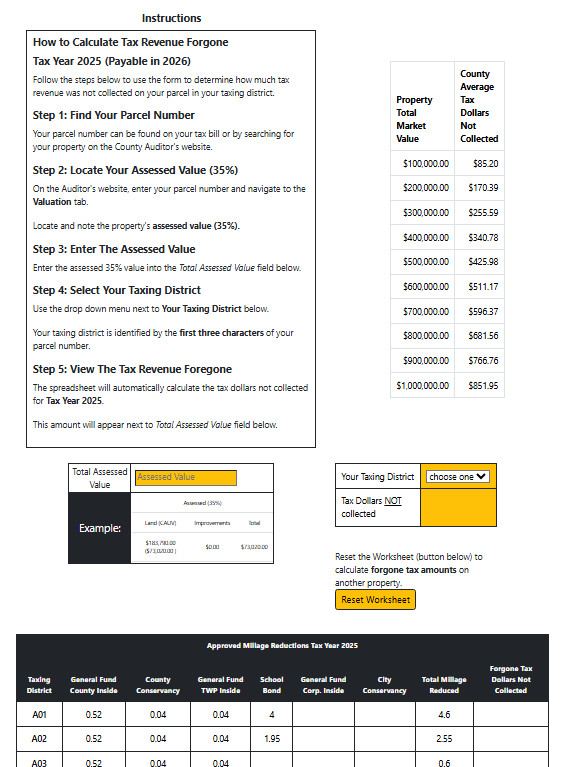
This page does not function as a public property tax lookup tool. It does not allow searches by owner name, parcel number, or address. Individual tax bills and payment history do not appear here.
Your Miami County Property Tax Bill
A Miami County property tax bill shows how much a property owner owes and how that amount is calculated. Each line explains charges tied to property value, local tax rates, and approved levies.
What appears on a Miami County property tax bill
Every tax bill follows a clear structure, so readers can trace each charge step by step. The top section lists property details such as parcel number, owner name, and location. This confirms the bill applies to the correct property. Below that, the bill breaks down the assessed value, which reflects a percentage of the property’s market value set through tax assessment. This figure forms the base for all calculations. The next lines show millage rates, which represent how much tax is charged per $1,000 of assessed value. Local schools, counties, cities, and special districts each apply their own rates.
Common line items include:
- Residential or land assessed value
- Total millage rates by taxing authority
- Gross tax amount before credits
- Credits or exemptions applied
- Final amount due
Each charge links directly to a public service or voter-approved levy. So the bill acts as both a payment request and a record of how local services receive funding.
What each charge means and why totals change
Each section of a Miami County property tax bill serves a purpose. The assessed value reflects property size, location, and use. Changes to this value often follow countywide reappraisals or updates to individual properties. Millage rates shift when voters approve new levies or older ones expire.
Tax bills may vary from year to year for several reasons:
- Property improvements raise assessed value
- Reappraisals adjust market-based figures
- New levies increase total millage rates
- Credits reduce the amount owed
Payment schedules matter too. Miami County property tax bills usually split charges into two installments, which can affect the visible balance at different times of the year.
Assessed Value and Property Valuation in Miami County
The assessed value of a property in Miami County represents the dollar value assigned by the county auditor for tax purposes. Property valuation helps determine how much a homeowner or investor owes in property taxes each year.
How Property Assessments Work
Property assessments in Miami County are conducted by the County Auditor’s office to estimate the fair market value of real estate. This value reflects what a property would likely sell for under normal conditions.
The auditor considers multiple valuation methods, including:
- Cost approach: Estimating the value based on the cost to rebuild the property minus depreciation.
- Sales comparison approach: Comparing the property to recent sales of similar homes nearby.
- Income approach: For rental or commercial properties, calculating value based on potential income generation.
Assessments are updated periodically to ensure tax bills accurately reflect property changes, improvements, or shifts in the local real estate market. Regular updates help maintain fairness and consistency for all property owners.
Reassessment Cycles in Miami County
Miami County follows a reassessment schedule to keep property valuations current. Typically, residential and commercial properties are reassessed every three to six years, although the exact cycle can vary depending on local regulations and market fluctuations.
During a reassessment:
- The auditor reviews property characteristics such as square footage, lot size, and building condition.
- Improvements, additions, or renovations are factored into the assessed value.
- Historical sales data and current market trends are analyzed to ensure accuracy.
Property owners receive notice of their updated assessment before it affects the tax bill. This allows homeowners to review the assessed value and compare it with similar properties in the county.
The Auditor’s Role in Property Valuation
The Miami County Auditor plays a central role in maintaining accurate property records. Responsibilities include:
- Assigning and updating assessed values for all properties.
- Maintaining property descriptions, legal boundaries, and ownership records.
- Providing access to assessment information for property tax lookup or public inquiries.
The auditor ensures that valuations are transparent, consistent, and reflect current market conditions. Accurate property valuation supports fair taxation and helps property owners understand the basis of their tax obligations.
Miami County Property Tax Due Dates and Payment Schedule
Miami County property taxes are typically due twice a year, with set deadlines in February and July. Missing these tax due dates can lead to penalties, interest, and a delinquent tax status. Property taxes in Miami County are billed semiannually, splitting the total yearly tax amount into two payments. The first installment is usually due by February 15, while the second installment is due by July 15. These dates are consistent for most residential and commercial properties, though special districts or newly assessed properties may have adjusted schedules. Residents receive tax bills in advance, providing clear amounts owed, assessed value, and instructions for payment.
Billing Calendar and Payment Methods
The county provides a structured billing calendar to help taxpayers manage payments:
- February 15: First half of the annual property tax is due
- July 15: Second half of the annual property tax is due
Payments can be made through several options:
- Online portal: Pay directly via the Miami County Treasurer’s website
- Mail: Send a check or money order with the tax bill stub
- In person: Payment accepted at the Treasurer’s office
Keeping track of the billing calendar ensures that property owners avoid late fees or unnecessary interest accumulation. Taxpayers should note that online payments may require confirmation of receipt, so it’s wise to allow processing time before deadlines.
Consequences of Missing Deadlines
Failing to meet Miami County property tax due dates triggers several financial consequences. First, penalties are applied immediately after the due date, typically calculated as a percentage of the unpaid amount. Next, interest accrues monthly on delinquent balances, increasing the total owed. Prolonged non-payment can lead to delinquent tax status, which may result in liens or public auctions of the property if taxes remain unpaid.
Property owners can avoid these issues by:
- Marking deadlines on personal calendars or digital reminders
- Verifying payment via the Treasurer’s online system
- Contacting the Treasurer’s office promptly if any billing discrepancies occur
How to Pay Property Taxes in Miami County
Paying property taxes in Miami County can be completed online or in person. Residents can choose the method that fits their schedule and receive confirmation immediately after payment.
Online Payment Methods
Miami County offers a convenient online payment portal for property taxes. Homeowners can use a computer or mobile device to complete payments securely. The portal accepts electronic payments via credit cards, debit cards, or direct bank transfers.
Steps for online payments:
- Visit the Miami County Auditor or Treasurer’s official website.
- Select Property Tax Payment.
- Enter your parcel number, property address, or account information.
- Choose your payment method and follow prompts to complete the transaction.
- Receive an electronic tax receipt confirming your payment.
Online payments often post immediately, which ensures your tax records are updated. Keeping a record of the payment allows residents to track their payment history for future reference.
Mail and In-Person Payment Options
For residents preferring traditional methods, property taxes can be paid by mail or in person.
Mail Payments:
- Include a check or money order made out to the Miami County Treasurer.
- Include the remittance stub from your tax bill.
- Mail to the Treasurer’s office address, ensuring the postmark is on or before the due date.
In-Person Payments:
- Visit the Miami County Treasurer’s office during business hours.
- Payments can be made using cash, check, or electronic card payments.
- Staff can provide an immediate receipt for your records.
Both methods update your property tax account and ensure the payment is reflected in your payment history.
Payment Confirmation and Record-Keeping
After any payment, whether online, by mail, or in person, keeping proof is important. An official tax receipt serves as verification and helps track assessed value changes, penalties, or adjustments. Residents can check their payment history through the online portal, which lists past and current payments with dates and amounts. Maintaining accurate records is particularly useful for real estate transactions or tax reduction applications. With proper documentation, homeowners can avoid late fees and ensure their Miami County property tax account remains current.
Viewing Payment History and Past Tax Records
Residents and property owners in Miami County can review their payment history and previous tax records to track past payments and verify balances. These records are essential for confirming completed payments and reviewing any past due balances. Keeping track of Miami County tax records helps homeowners, buyers, and sellers maintain clear financial documentation. Payment history provides a detailed account of all transactions, including amounts paid, dates, and any penalties applied. This information is often stored in the county’s tax archive, making it accessible for multiple years.
How to Check Payment History
Property owners can view their prior payments through the Miami County Auditor or Treasurer’s office. The process typically involves:
- Visiting the official Miami County tax portal.
- Enter the parcel number, property address, or owner name.
- Reviewing a summary of previously paid taxes, any past due balances, and payment dates.
- Printing or saving records for personal or legal purposes.
Some records may include additional details such as penalties, interest charges, and payment methods, which can be helpful when resolving disputes or verifying payments.
Importance for Buyers and Sellers
For property buyers, reviewing the payment history ensures there are no outstanding taxes that could transfer with ownership. Sellers benefit by providing a clear record of tax compliance, which can increase buyer confidence. Agents and investors often examine the tax archive to estimate yearly property costs and plan future investments. Keeping these records organized also simplifies interactions with banks, lenders, or legal entities that may require verification of past property tax payments. By regularly reviewing Miami County tax records, property owners maintain financial transparency and reduce the risk of surprises from unpaid balances.
Property Tax Exemptions and Credits in Miami County
Property owners in Miami County can qualify for several property tax exemptions and credits that lower the amount owed on their annual tax bill. These programs provide tax relief for seniors, disabled residents, farmers, and homeowners who meet specific eligibility requirements.
Homestead Exemption
The Homestead Exemption reduces the taxable value of a primary residence, directly lowering property taxes for qualifying homeowners. This benefit is available to residents who own and occupy their home as their primary residence.
- Reduces taxable property value by a set amount determined by county rules.
- Automatically applies once eligibility is verified with the Miami County Auditor’s office.
- Provides long-term savings, helping homeowners manage recurring tax obligations.
Eligibility generally requires proof of ownership and residency. Homeowners must file the proper forms, and the exemption is renewed annually, ensuring continued financial relief.
Senior and Disability Credits
Seniors and residents with qualifying disabilities may be eligible for tax credits that further reduce their Miami County property tax. These credits can significantly lower annual tax bills and are intended to ease financial burdens.
Key points:
- Available to residents age 65 or older or those with permanent disabilities.
- Credit amounts are based on income and property value limits.
- Applicants must submit documentation proving age, income, and residency.
These programs help older adults and disabled residents maintain financial stability while keeping their homes.
Agricultural Exemptions
Farmers and landowners in Miami County can benefit from agricultural exemptions, which reduce property taxes on farmland or agricultural buildings. These exemptions encourage land preservation and support the local farming economy.
Highlights include:
- Tax relief for land actively used for agriculture, including crops and livestock.
- Reductions calculated based on current-use valuation, rather than full market value.
- Requires annual certification to demonstrate that the property is in agricultural use.
By lowering the taxable value of farmland, the exemption helps farmers maintain operations and invest in their property.
Applying for Exemptions and Credits
Property owners must file the appropriate applications with the Miami County Auditor to claim any exemption or credit. Key steps include:
- Determine eligibility based on age, residency, disability, or land use.
- Complete the required forms, available from the Auditor’s office.
- Submit forms before the county deadline to ensure the benefit applies for the current tax year.
These programs form part of Miami County’s property tax reduction efforts, giving residents an opportunity for meaningful financial relief while maintaining compliance with county tax requirements.
Agricultural and Historic Property Tax Benefits
Agricultural and historic properties in Miami County may qualify for significant tax benefits, which can lower annual property tax bills. These programs help support farmland conservation and preserve historic landmarks while reducing the financial burden on property owners.
Agricultural Property Tax Benefits
Owners of farmland in Miami County can take advantage of the Current Agricultural Use Value (CAUV) program, which calculates property taxes based on agricultural productivity rather than market value. This often results in a lower assessed value for farmland, making property taxes more manageable for farmers and landowners.
Key aspects of the CAUV program include:
- Eligibility: Land must be actively used for agriculture and meet minimum acreage requirements.
- Assessment: Tax is based on soil type, crop productivity, and land use rather than market trends.
- Conservation Use: Participating properties often maintain open space or natural resources, which can further support tax reductions.
For example, a 50-acre farm producing corn and soybeans could see its assessed value drop significantly compared with a standard residential valuation. This encourages long-term agricultural use while supporting sustainable farmland practices.
Historic Property Tax Benefits
Miami County also provides tax relief for properties with historic designation. Owners of homes, buildings, or landmarks recognized as historically significant may qualify for reduced property taxes. This helps maintain the integrity of historic structures and encourages preservation.
Important points regarding historic property tax benefits include:
- Eligibility: The property must be listed on a local or national historic registry.
- Impact on Taxes: Assessments may be reduced to reflect preservation needs rather than market-driven value.
- Community Benefit: Historic preservation contributes to cultural heritage and neighborhood character.
Owners should contact the Miami County Auditor’s office to verify eligibility and learn about specific application requirements. Proper documentation of historic status and property use is required to receive tax benefits.
How to Apply for a Property Tax Reduction in Miami County
Homeowners in Miami County can apply for a property tax reduction to lower their annual tax bills if they meet certain eligibility requirements. The process involves submitting the correct forms within specified deadlines and may include requesting a reassessment or participating in an appeals process. Applying for a property tax reduction in Miami County starts with determining eligibility. Common reductions are available for seniors, disabled residents, veterans, and agricultural property owners. Each program has specific criteria, so it’s important to identify which reduction fits the property type and personal circumstances. Eligible applicants may see significant savings on their annual property taxes, sometimes reducing the tax liability by several hundred dollars.
When to Apply
Applications for property tax reduction in Miami County are generally submitted annually, often coinciding with the tax assessment cycle. For most reductions, applications should be filed before the tax due date for the first half of the year, usually in early February, or for certain programs, by mid-year. Missing these deadlines can delay approval until the following tax cycle, so homeowners should plan to submit forms early in the assessment period.
Required Forms
Miami County requires specific forms depending on the type of reduction requested. Some commonly used forms include:
- Homestead Exemption Application – for senior and disabled residents
- Agricultural Property Tax Application – for farmland or conservation use
- Veterans Property Tax Reduction Form – for qualifying military veterans
Each form asks for property details, ownership information, and documentation proving eligibility, such as proof of age, disability, or veteran status. Applicants may also need to attach copies of prior tax bills or property deeds to support their claim.
Filing Deadlines and Process
After completing the appropriate forms, submissions can usually be made online, by mail, or in person at the Miami County Auditor’s office. The office reviews the applications, which may trigger a reassessment request if the current assessed value does not reflect eligible reductions. Homeowners can also enter an appeals process if their initial request is denied or if they disagree with the reassessed value.
- Complete the relevant application form accurately.
- Attach all required supporting documents.
- Submit the form before the official deadline.
- Track the status of the application and respond promptly to requests for additional information.
Property owners should keep copies of all forms and correspondence. Approved reductions will appear on the next tax bill, lowering the amount due. Many residents report that applying early and providing complete documentation helps avoid delays and ensures reductions are applied for the current tax year.
How Miami County Property Tax Rates Have Changed Over Time
Miami County property tax rates have generally followed a steady pattern, with modest increases reflecting inflation, local funding needs, and voter-approved levies. Over the past decades, these rates have been influenced by economic shifts, school district budgets, and municipal services. Historically, Miami County maintained property tax rates between 1.5% and 2.5% of assessed property value, though the exact rate varies depending on local levies and township-specific needs. For instance, school funding often accounts for a significant portion of total taxes, while city and township levies can cause small annual adjustments.
Historical Trends in Miami County Property Taxes
- 1990s–2000s: Property tax rates remained relatively stable, with incremental increases primarily tied to school levies. Voter-approved bond issues occasionally raised rates for infrastructure projects.
- 2010–2015: Rates saw moderate increases following the economic recession, reflecting higher local service costs and the need to fund public safety and education.
- 2016–2025: Annual changes were smaller, often under 0.2% per year, but property reassessments periodically adjusted the tax burden on individual homeowners.
These historical trends show a consistent approach: rates are designed to balance local revenue needs without causing sudden spikes for property owners.
Factors Affecting Rate Changes
Several elements influence changes in Miami County property tax rates:
- Local Levies: Voter-approved levies for schools, emergency services, or infrastructure often increase rates for specific years.
- Property Reassessments: Updates to assessed property values can raise or lower individual tax bills even if the overall rate stays stable.
- Economic Conditions: Inflation, state funding reductions, and rising service costs can indirectly affect local rates.
- Special District Taxes: Some areas may have additional levies for libraries, fire districts, or stormwater management.
Miami County Tax Trends (Illustrative)
| Year | Average Rate (%) | Key Factor |
|---|---|---|
| 2000 | 1.60 | School bond approval |
| 2010 | 1.75 | Public safety funding |
| 2020 | 1.85 | Reassessment impact |
| 2025 | 1.90 | Minor levy adjustments |
(FAQ) About Tax in Miami County
Residents often have questions about property taxes in Miami County, including how to find their bills, dispute assessments, handle late payments, and know who to contact for assistance. Understanding these details can help property owners manage taxes efficiently and avoid unnecessary penalties.
How do I find my tax bill?
Miami County property owners can access their tax bills online or receive them by mail from the treasurer’s office. Each bill lists the property’s assessed value, applicable millage rates, and payment deadlines. Property owners can use the official Miami County Treasurer website to search by parcel number, property address, or owner name. It is also important to confirm the mailing address with the auditor’s office to ensure bills are sent correctly. Reviewing the bill carefully allows property owners to understand their tax obligations and verify any exemptions or credits that may apply.
What if I disagree with my assessed value?
If a property owner believes the assessed value is inaccurate, they should contact the Miami County Auditor’s office to review or challenge the assessment. The auditor maintains detailed property records that include square footage, improvements, and prior assessments, which can help identify discrepancies. Property owners may submit supporting evidence, such as recent appraisals or sales data from comparable properties, to support their case. Filing a review or appeal within the designated deadlines can result in a corrected assessment and may reduce the property taxes owed.
Can I pay late?
While the Miami County Treasurer accepts late payments, overdue property taxes incur penalties and interest. The amount due increases over time, so timely payments are beneficial. The treasurer keeps a record of payment history for each property, which helps owners verify their balances and plan payments. Many residents choose online payments or automatic withdrawals to avoid missing due dates. If a property owner faces difficulty making a payment, contacting the treasurer’s office can provide guidance or information on available options.
Who do I contact for help?
For questions related to property taxes, residents should reach out to the Miami County Auditor or Treasurer’s offices. The auditor handles assessments, exemptions, and property valuations, while the treasurer manages billing, payments, and payment history. Both offices offer support by phone, email, and in person at their official offices. Checking the official office websites also provides access to forms, frequently asked questions, and other resources to help residents handle property tax matters efficiently.
How can I check if I qualify for exemptions or credits?
Miami County property owners may be eligible for property tax exemptions or credits that reduce the amount owed. These can include homestead exemptions, senior or disability credits, and agricultural or historic property benefits. To determine eligibility, property owners should consult the Miami County Auditor’s office, which maintains detailed records of exemption programs and criteria. Applications typically require supporting documents, and filing within the designated deadlines ensures consideration for the current tax year. Reviewing available exemptions can significantly lower a property’s tax burden and help residents manage payments more effectively.